


Unmanned Ground Vehicles (UGV)
Discover cutting-edge solutions from leading global suppliers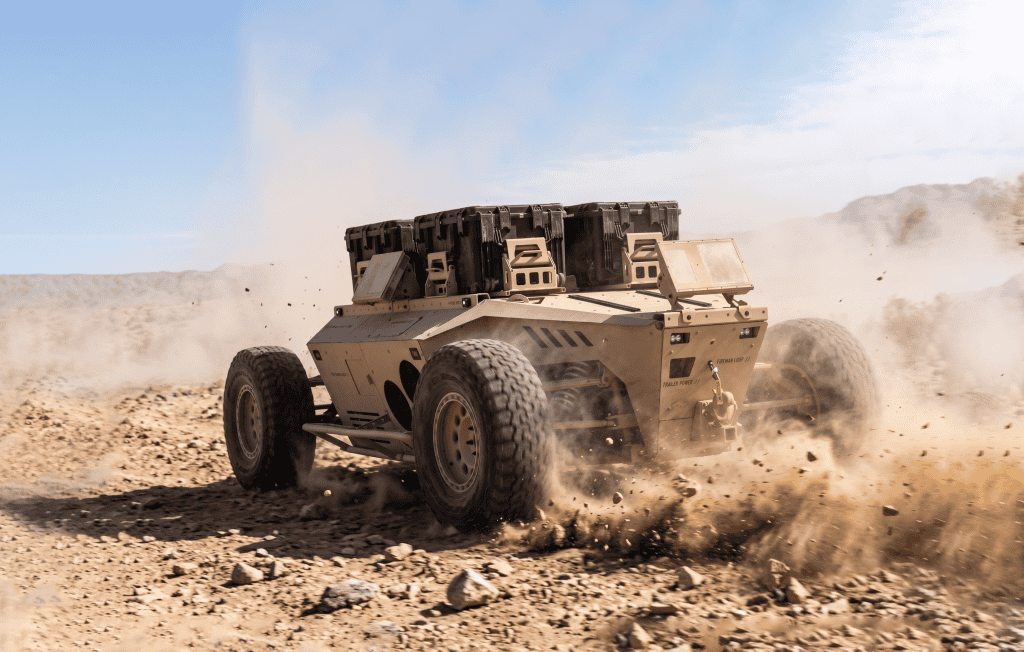
Hypercraft has launched Razorback, a next-generation software-defined Unmanned Ground Vehicle (UGV) designed to serve as a flexible mission platform for the modern battlespace.
The vehicle arrives as a direct response to evolving global threats and the liabilities associated with traditional logistics chains and personnel-heavy operations. By providing persistent operational energy and long-range ground mobility, the platform allows for the transformation of vehicle functionalities to meet shifting mission requirements through its software-defined architecture.
Engineered for high-consequence environments, the Razorback is powered by a diesel hybrid-electric powertrain. This system features a 50 kW range extender with a 95 kW peak, paired with a four-motor torque-vectoring drive system producing 300 hp. These specifications allow the vehicle to transport a 2,400 lb payload across a 280-mile range, reaching speeds of up to 60 mph.
At the core of the platform is a Modular Open System Architecture that decouples hardware from software. This central-zonal design enables high-performance computing for AI and edge processing, while facilitating over-the-air updates and rapid mission-set swaps. The vehicle also functions as a tactical microgrid, providing 38 kW of exportable power capable of supporting directed energy weapons, electronic warfare systems, and vehicle charging stations.
For operations in austere or contested terrain, the 148-inch chassis is equipped with 4-wheel hydraulic steering, neutral steer capabilities, and 37-inch tires. The propulsion system is designed with redundancy in mind; the vehicle can maintain operation even if multiple motors, the range extender, or the energy storage systems sustain damage.
The platform is configured to support a broad spectrum of autonomous mission sets, including C-UAS protection against Group 1 and 2 threats, casualty evacuation with onboard power for life-sustaining equipment, and contested logistics. It can also serve as a mobile communications relay or an electronic warfare node to bridge command and control gaps in obstructed environments.
Brian Bowers, CEO at Hypercraft, said, “Razorback isn’t just a vehicle; it’s the new tactical standard. Razorback responds to the dynamic demands of modern warfare, unifying high-capacity power export in a high-performance off-road vehicle with advanced autonomous capabilities to ensure that forward operations succeed in an ever-changing environment.”
By integrating advanced propulsion with a software-centric approach, Hypercraft aims to lead the transition toward autonomous warfare at the tactical edge.