Cargo Drones
Discover cutting-edge solutions from 4 leading global suppliersSoaring has taken part in a U.S. Army field exercise examining the use of autonomous aerial logistics systems for medical resupply missions in contested operational environments.
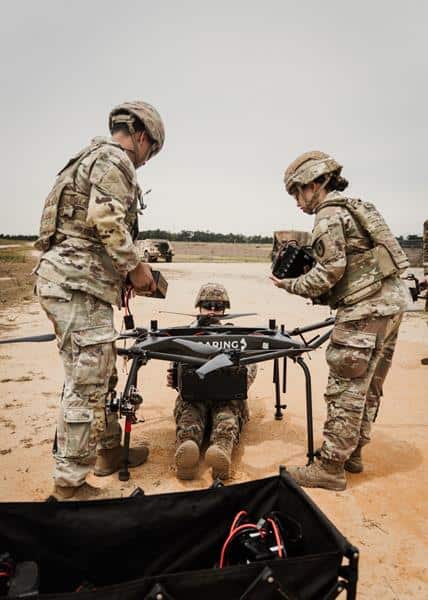
The exercise was conducted alongside the XVIII Airborne Corps 44th Medical Brigade and focused on evaluating how unmanned aircraft can support Class VIII medical sustainment when conventional ground transportation is limited by terrain, operational constraints, or threat conditions.
Over a multi-month preparation period, Soaring coordinated with Army personnel to support the validation effort, which compared aerial resupply operations against traditional ground-based logistics methods. The assessment examined factors including response speed, manpower demands, and sustainment effectiveness across a range of mission scenarios.
According to the company, drone-enabled deliveries were able to maintain the movement of medical supplies in situations where ground access was disrupted. The exercise also demonstrated the ability to conduct repeated aerial resupply missions in support of operational demand.
For the evaluation, Soaring deployed two of its M25 autonomous aircraft systems, each capable of carrying payloads of up to 25 lbs across 10-kilometer round-trip routes. Soldiers without prior drone experience were trained to assemble, launch, and recover the systems, reaching operational proficiency within four days. Setup-to-launch timelines of approximately 13 minutes were also recorded during the exercise.
The field activity further demonstrated how autonomous aerial logistics systems could help reduce personnel and vehicle exposure in contested environments while integrating into existing sustainment structures. Additional use cases were also explored for other supply categories, including food, ammunition, and repair components.
Fairborz Maseeh, Soaring’s Board Chairman, commented, “Effective sustainment at scale depends on aligning emerging technologies with real operational requirements. Our focus is on working alongside the Army to help define and deliver autonomous logistics capabilities that are designed for real-world use and can be adopted, integrated, and sustained across the force.”
Lieutenant Colonel Yu-Sheng Chen, added, “Exercises like this are critical to validating how new capabilities perform under real operational conditions. Our priority is ensuring units can sustain medical support when time, terrain, or threat conditions limit traditional resupply.”
Soaring said the exercise reflects broader efforts across the military to evaluate emerging logistics technologies through operational testing with deployed units rather than controlled demonstration environments.