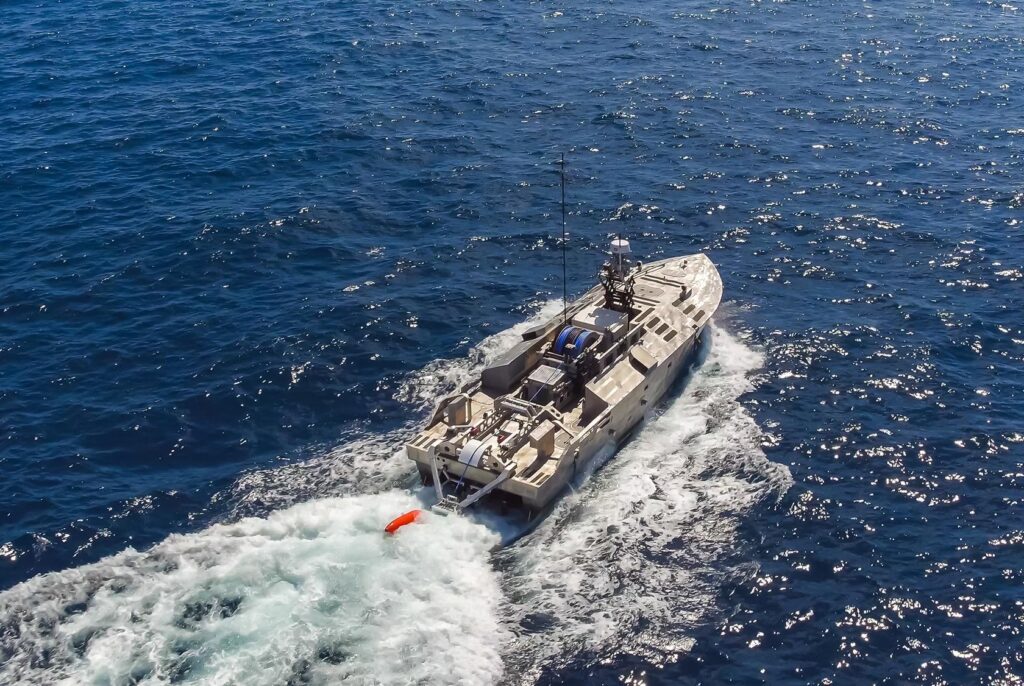
Unmanned Surface Vehicles
Discover cutting-edge solutions from leading global suppliers
Saildrone and Lockheed Martin have entered a partnership to integrate combat-tested payloads with autonomous Unmanned Surface Vehicles (USVs) to enhance the capabilities of the United States Navy’s future hybrid fleet.
This collaboration aims to field lethal maritime capabilities at a pace and scale that meets modern naval demands. The initial phase of the partnership involves equipping the 20-meter Saildrone Surveyor with Lockheed Martin’s JAGM Launcher. The Surveyor is an extreme-range, high-endurance USV designed for persistent Intelligence, Surveillance, and Reconnaissance (ISR) as well as deep-ocean mapping. It is capable of autonomous operation for several months in harsh environments with minimal human intervention.
A $50 million investment from Lockheed Martin into Saildrone will facilitate these integrations and provide command and control enhancements. These upgrades are intended to allow Saildrone platforms to execute diverse mission sets, including fleet defense, signals intelligence, reconnaissance, and strike operations. Proof-of-concept integrations and a live-fire demonstration are currently scheduled to take place in the summer of 2026.
Beyond the current Surveyor platform, larger Saildrone USVs are in development to accommodate a broader range of Lockheed Martin technologies, such as the Mk 70 VLS launcher. By combining commercial autonomous sailing technology with defense systems, the companies seek to realize the Navy’s strategic goal of distributed maritime operations, where manned warships work in concert with unmanned vehicles.
Saildrone platforms are already utilized for year-round missions by the US Navy and Coast Guard, having first been deployed in 2021. These American-manufactured, ABS-classed vehicles have supported operations in the Middle East, Caribbean, Atlantic, and Pacific. Recently, they were utilized in Operation Southern Spear to detect and track vessels involved in smuggling illicit contraband along the US southern border.
The scale of current operations is significant; in the past year, Saildrone vehicles have spent over 10,000 cumulative days at sea. During that period, the fleet covered 380,000 nautical miles and detected more than 2.3 million unique vessels, providing operators with near-real-time intelligence and a common operating picture to accelerate decision-making.