
Jake Rawson, Head of Business Development at ZeroAlpha Solutions, spoke to Defense Advancement about the company’s DSEI 2025 objectives and its latest innovations in sustainable power and lighting technologies.
In an exclusive Q&A, Jake Rawson explained how systems like FOBGrid enhance energy resilience in forward operating bases, the distinct capabilities of the FOBLite lighting series, and the M-RZR Auxiliary Power Module for off-grid vehicle support.
Jake Rawson also highlighted ZeroAlpha’s investments in micro-gridding, emphasizing scalable energy storage and efficient distribution, while showcasing the company’s commitment to collaboration, end-user support, and advancing defense-sector energy solutions.
What are ZeroAlpha Solutions’ strategic objectives for exhibiting at DSEI 2025, and how do you intend to highlight your capabilities in sustainable power and lighting technologies during the event?
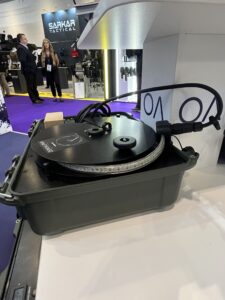
Our strategic objectives include showcasing new products, and I think this is a perfect opportunity to do so. Holding this event every two years provides a strong milestone to work towards, it allows us to keep momentum, continuously improve, iterate, and ensure we meet user demand for diverse, high-quality solutions.
Contrary to what some may think, UK Defence collaborates effectively, and this event is a great opportunity to bring everyone together, end users, government departments, and other manufacturers, to exchange ideas and drive progress.
It’s all about supporting the end user. For example, if one company has an excellent vehicle that needs exportable power, and we have the power solution but not the vehicle, it makes perfect sense to align our capabilities before presenting it as a future opportunity. All of this coordination and collaboration happens in the background to ensure we deliver the most effective solutions.
How does the FOBGrid system improve energy resilience and logistics efficiency in forward operating bases or early-entry deployments?
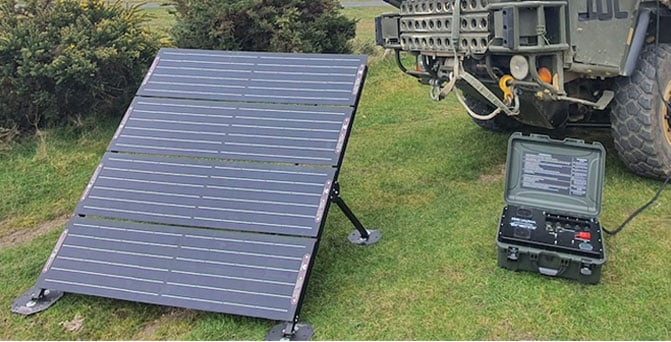
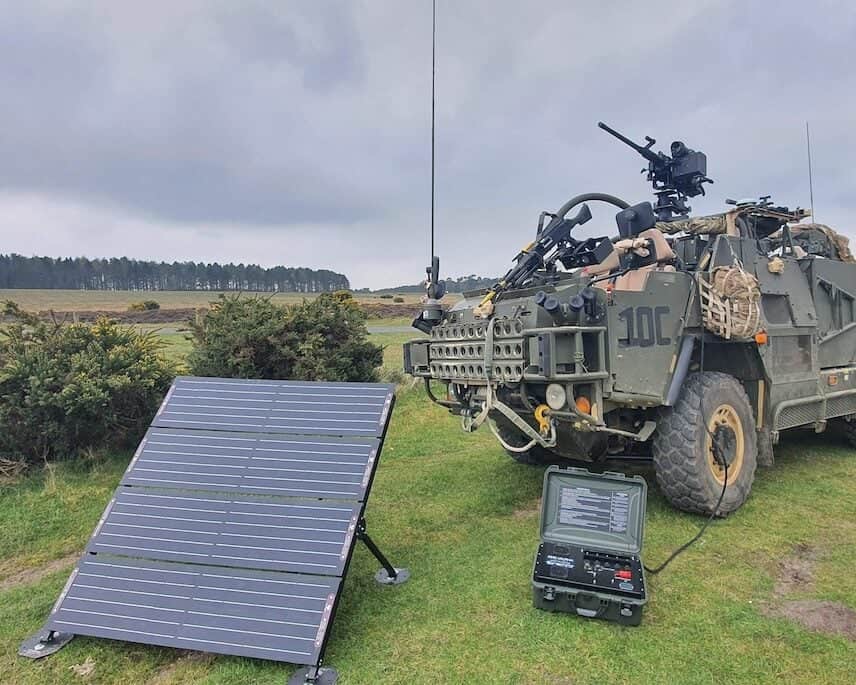
The FOBgrid series of systems are, in civilian terms, uninterrupted power sources. Essentially, they sit in line with a power generation source, whether that’s a vehicle, a diesel generator, or another system, and allow you to store energy effectively.
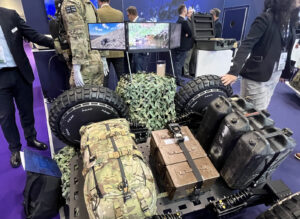
The main challenge users face is that while they can generate energy, they often cannot store or distribute it efficiently. FOBgrid systems address this by storing energy at various scales and in different form factors, enabling silent operation. When a vehicle shuts down or a generator turns off, the stored watt hours can be used to power essential systems. The key advantage is that these systems are silent and largely emission-free. In tactical situations, they allow you to continue operations off the batteries if generators or vehicles cannot run.
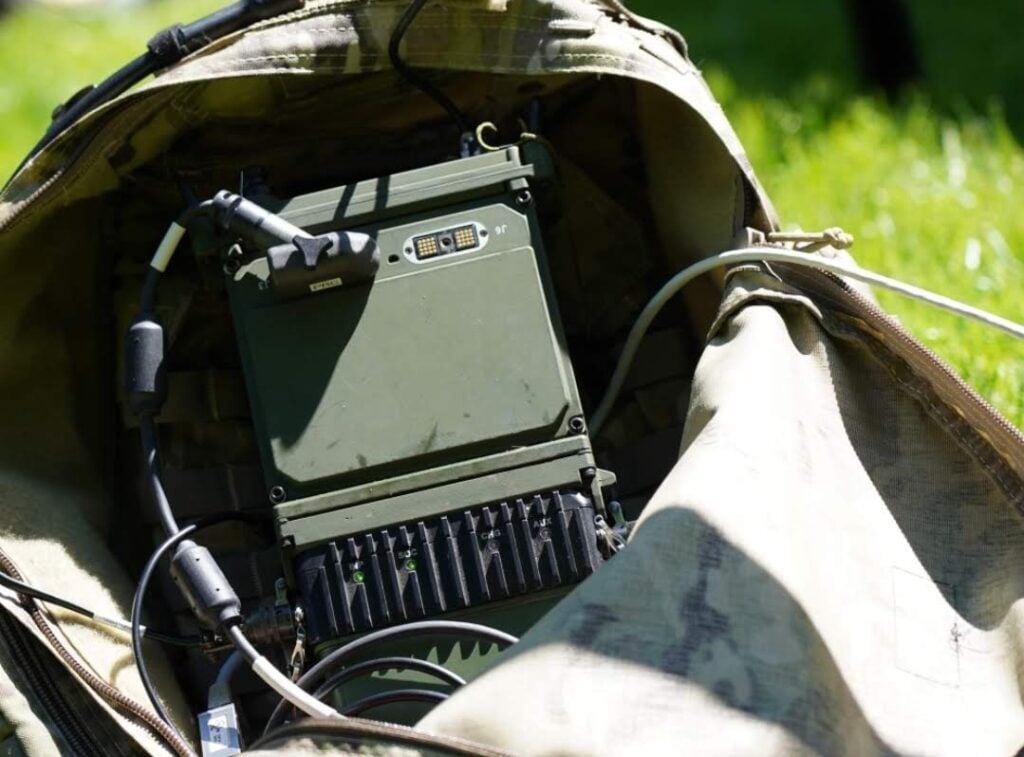
A new addition to the series is the FOBGrid 2590. Its design leverages batteries already in service, so there’s no need for additional investment in batteries. Users can simply integrate them into a box to create a large energy bank. It’s straightforward technology, but it makes a significant difference, particularly in terms of air portability and G4 operations.
What are the key differences between the FOBLite HQ and FOBLite 360, and how does each model meet distinct mission requirements?
The FOBLite series includes the FOBLite HQ, a strip light that runs off 25–90 mm systems. It’s a real workhorse because it provides an excellent power source and stores a lot of energy for its size. It’s primarily used for tent lighting, offering up to 3.5 metres of illumination from the battery alone, eliminating the need for a generator.
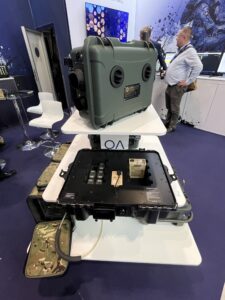
Currently, users often rely on diesel generators at 110 volts just to power lights. By using FOBLite HQ, they can remove the generator and avoid consuming around 24 litres of fuel per day while still getting the lighting they need. This has proven to be highly effective.
The FOBLite 360 is a 12-volt work light that can be charged from a vehicle or other sources. It provides 360-degree illumination for a wide range of tasks. Units frequently use it for engineering work, rehearsals, and other operational activities. These two lighting systems serve very different use cases but have both been highly successful with the MoD.
Can you explain how the MRZR Auxiliary Power Module integrates with light tactical vehicles and supports mission endurance in off-grid conditions?
The Auxiliary Power Module, or APM, addresses a key challenge for small vehicles: how to store and distribute energy. Many vehicles lack a secondary battery or emission systems, which can be a major limitation for users.
We offer the M-RZR APM, designed to fit at the bottom of the vehicle’s load bed, leaving space for other equipment on top. It provides 2.4 kWh of stored energy.
We also have the DC APA, a more modular system with slightly higher energy storage. Its versatility allows it to be used across different land platforms. Using standard NATO slave leads, it can be charged from any compatible vehicle and then provide power to other systems or teams in the field.
Looking ahead, which areas of deployable power, energy, or lighting solutions are you investing in most heavily, and how do you see ZeroAlpha’s role evolving in the defense sector?
A crucial part of our development is micro-gridding. This approach involves having multiple systems that can communicate with each other, allowing them to combine their energy or provide power to a single point as needed. We are investing heavily in micro-gridding and have developed a prototype system that enables energy to be stored and distributed efficiently at scale.