Tactical UAS
Discover cutting-edge solutions from 7 leading global suppliers
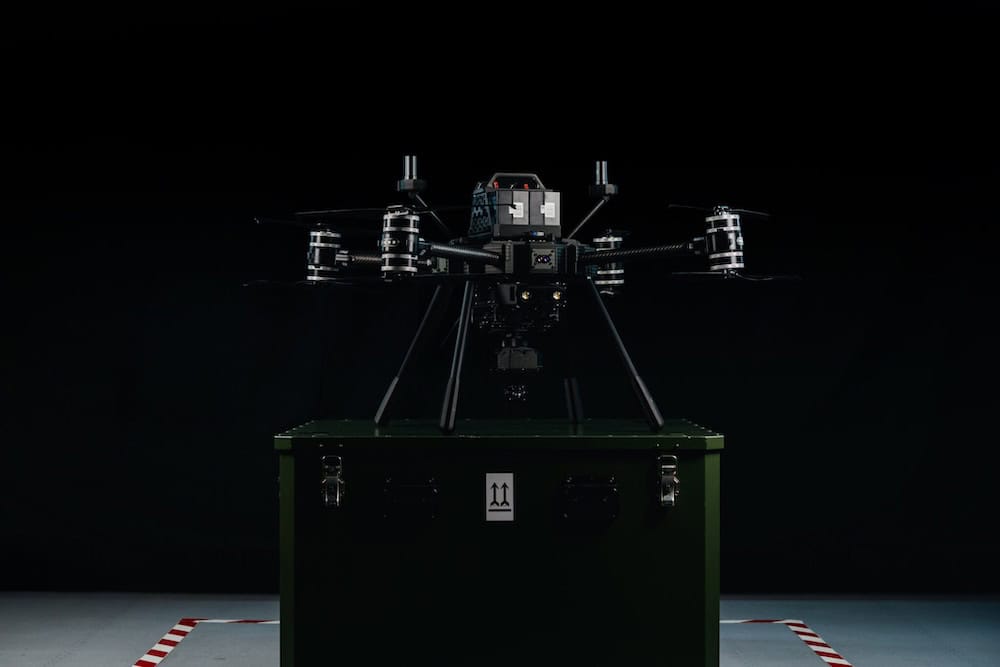
Live missile integration on heavy-lift UAVs has long been considered a challenging step in advancing unmanned aerial warfare. Rotron Aerospace has reported that its Talon DT-300 achieved this capability during demonstrations at a U.S. military proving ground. Read more >>
During the flights, the VTOL UAV launched both the APKWS laser-guided rocket and the Javelin anti-tank missile under operational conditions.
The demonstrations included successful target acquisition, laser designation, and direct strikes at a distance of up to 40 kilometers from the ground control station. More than a proof of concept, the company emphasizes that the results highlighted the DT-300’s payload integration, flight stability, and munition release performance.
Missile Launch Demonstrations
The live-fire events were conducted in two phases:
- APKWS trial: Conducted at 900 feet above ground level against a GPS-positioned target. The munition achieved a direct impact within approximately 1.1 meters of the designated aim point, with stable launch performance maintained in moderate crosswinds.
- Javelin trial: Conducted at 1,200 feet above ground level against a stationary light-armored vehicle. The missile achieved a successful strike that neutralized the target, also under moderate crosswind conditions.
Alex Head, CEO, Rotron Aerospace, stated, “The DT-300 is no longer just a logistics or ISR drone. It’s a fully armed, autonomous battlefield asset ready to support frontline forces.”
Stability Under Fire
One of the defining results of the demonstrations was the UAV’s ability to maintain stability during missile release in crosswind conditions, with gusts reaching up to 16 knots. The DT-300 sustained its target lock through Hood Tech’s gimbal system while keeping yaw deviation under 2° during APKWS ignition and pitch stability within 1.3° during Javelin launch. This level of control ensured safe missile separation and strike accuracy, addressing a well-known challenge for unmanned systems deploying heavy kinetic payloads.
Tactical Applications
Rotron Aerospace highlights that the successful launches broaden the potential role of the DT-300 on the battlefield. The platform offers a means of conducting anti-armor engagements from unmanned aircraft and providing close air support without placing crewed aircraft at risk. Its ability to deliver precision strikes in denied or GPS-contested environments increases operational flexibility, while integration into distributed swarm or ISR-strike concepts could further enhance force projection.
Col. Kevin Oliver commented, “Range equals protection, and protection equals safety. The further we can strike, the safer our forces remain.”
Counter-UAS Role
Beyond direct strike missions, Rotron Aerospace also points to the DT-300’s potential in counter-unmanned aerial systems (C-UAS) operations. While not part of the live demonstrations, the company suggests the UAV could support interception roles by employing APKWS against smaller, agile threats and Javelin against larger or more resilient unmanned platforms.
This layered response could allow aerial engagement of hostile drones before they reach defended areas, while offering flexible positioning in complex terrain. Such capabilities may be particularly relevant for protecting forward bases, convoys, and high-value assets in environments where adversary drones are increasingly deployed.
Conclusion
The Talon DT-300’s missile demonstrations underscored Rotron Aerospace’s efforts to advance heavy UAV capabilities beyond logistics and ISR. With proven missile integration, stable launch performance in challenging conditions, and potential applications in both precision strike and counter-UAS missions, the system demonstrates a multi-role capacity aligned with evolving battlefield requirements.