




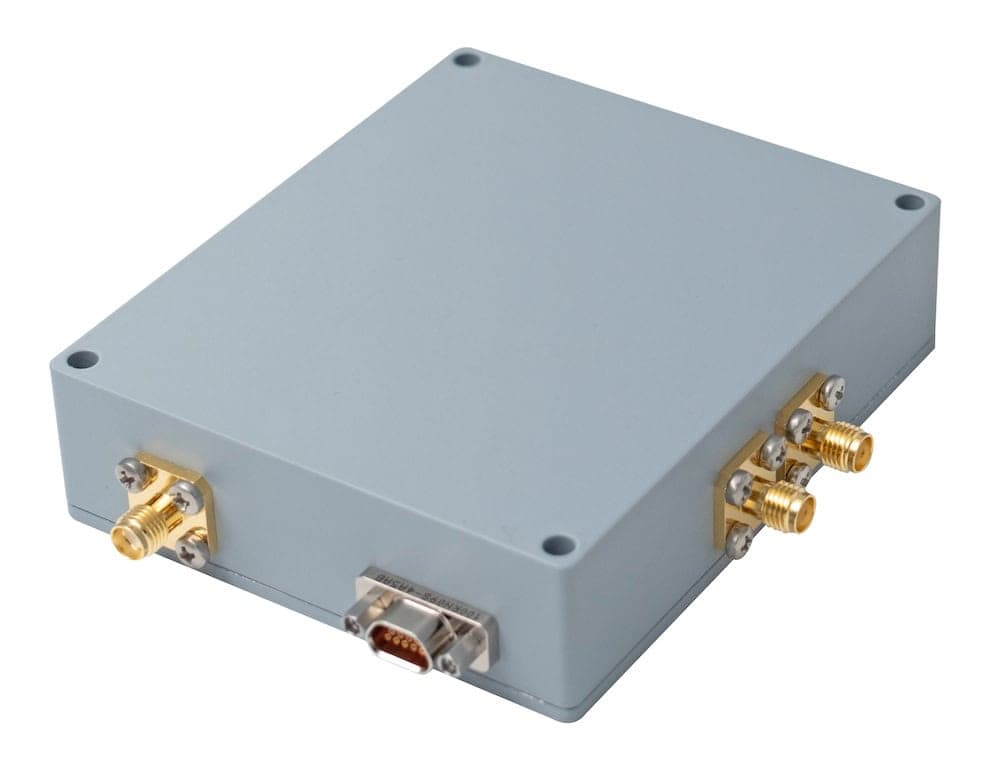
The active radar reflector is a compact, programmable system developed to emulate radar signatures for training, testing, and evaluation activities. Operating across the C, X, and Ku bands (5–18 GHz), it receives incoming radar signals, amplifies them, and retransmits them at a programmed Radar Cross-Section (RCS) level, enabling controlled and repeatable signature generation.
A two-antenna architecture supports efficient operation and accurate replication of radar returns, allowing realistic simulation of both airborne and surface targets during exercises and validation scenarios. Compatibility with RHCP and LHCP spiral antennas enables operation across all polarization types, supporting a wide range of radar systems.
The system incorporates an integrated programmable attenuator, allowing gain levels to be adjusted via an RS-232 interface. Configuration settings can be stored in memory, supporting pre-mission setup or in-mission adjustment depending on operational requirements.
Lightweight and power efficient, the reflector is designed for deployment across a variety of defense platforms and test assets. Built to meet MIL-STD requirements, it supports applications including radar seeker validation, electronic warfare training, target simulation, and guidance system testing.
| Frequency Range: | 5–18 GHz |
| Max. Gain: | > 60 dB |
| RF Attenuation Range: | 0–31 dB |
| Input Voltage (V): | 16–32 VDC |
| Operating Voltage & Input Current: | Max. 150 mA @ 28 VDC |
| Power Consumption (W): | < 4 |
| Programming Interface: | RS-232 |
| Connectors: | SMA, 9-pin Micro-D Socket |
| Dimensions (cm): | 9.5 × 6.2 × 1.6 |
| Weight (g): | 192 |
| Operating Temperature (°C): | -40 to +80 |
| Environmental Condition: | MIL-STD-810G |
| EMI / EMC: | MIL-STD-461F |






