



EMI/RFI Filters
Discover cutting-edge solutions from leading global suppliers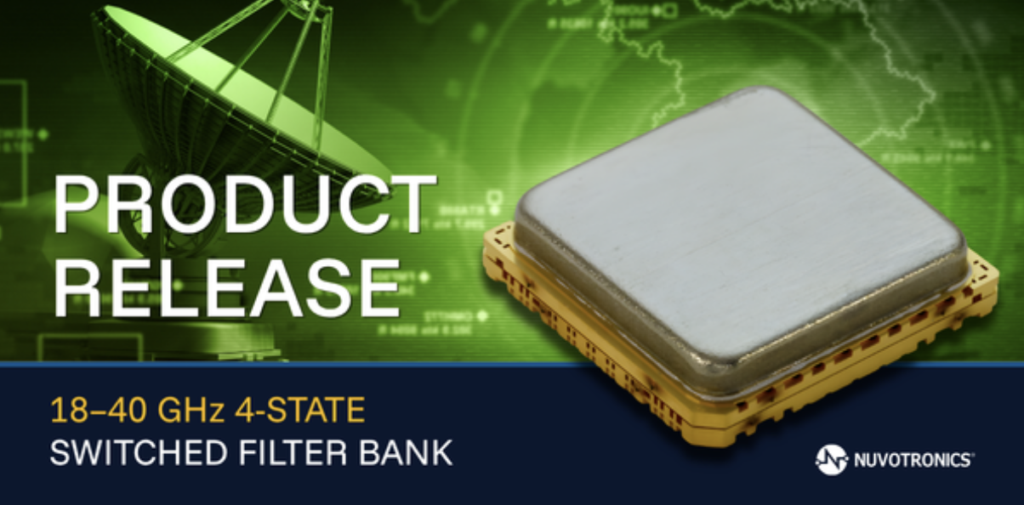
Nuvotronics has released a new 18–40 GHz, 4-state switched filter bank designed to provide high isolation and fast switching for modern software-defined radios.
This new capability addresses the increasing demand for frequency-agile radios that require reduced size, weight, and power (SWaP) without sacrificing technical performance. Engineered specifically for contested spectrum environments, the solution facilitates reliable channel selection while maintaining critical system link budgets. As a specialist in high-performance radio frequency and mmWave solutions for commercial and defense applications, Nuvotronics developed this unit to support highly integrated, next-generation architectures.
“Nuvotronics continues to push the boundaries of RF performance while reducing size and weight for mission-critical systems,” said Scott Meller, Vice President & General Manager, Nuvotronics. “Our new 18–40 GHz switched filter bank is engineered for high isolation and fast switching in a compact form factor —enabling SDRs to maintain system link budgets and operate effectively in congested and contested RF environments.”
Technically, the hardware features four distinct channels spanning 17.5–24 GHz, 23–29.5 GHz, 28.5–35 GHz, and 34–40 GHz. The system provides up to 75 dB rejection with an insertion loss of less than 7.5 dB per channel. It achieves switching speeds of under 200 ns and supports hot switching up to 24 dBm, ensuring agile operation in dynamic RF settings.
“SDRs increasingly require compact, precision-engineered filtering capabilities that can be easily integrated into complex RF architectures,” said Tom Dekker, Senior Product Manager, Nuvotronics. “Unlike traditional cavity and suspended substrate filter technologies, Nuvotronics’ switched filter bank delivers up to six times size and weight reduction while maintaining high performance. The compact footprint and SMT launches simplify integration into high-density PCBA designs, helping engineers reduce system complexity without compromising capability.”
The use of surface mount technology (SMT) launches allows for easier integration into high-density printed circuit board assembly designs. This approach helps engineering teams reduce overall system complexity while maintaining the high performance required for modern communication and defense systems.