


Accelerate Defense Modernization through Strategic Sourcing
Discover cutting-edge solutions from leading global suppliers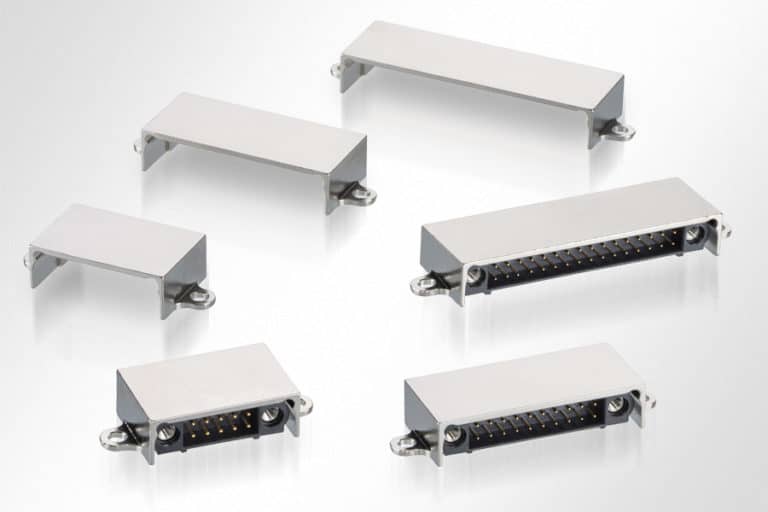
In order to provide comprehensive EMI/RFI protection across both horizontal and vertical planes, Harwin has made further additions to its metal backshell shielding options.
Harwin now offers backshells for its horizontal Datamate J-Tek connectors which will address increasingly commonplace right-angle interconnect orientations. These backshells mate directly with the cabling metal backshells that Harwin already has for its female Datamate cable connectors.
The new Datamate backshells mean that a fully EMI/RFI shielded connection can be established in a horizontal PCB to cable connection. They complement the vertical PCB to cable connection shielding products previously available from Harwin. These backshells ensure complete shielding when used in conjunction with a ground plane.
Harwin’s horizontal backshells are not attached to the connector, but placed over them and then independently secured to the board. This means that inclusion of shielding can be factored into the design at a much later stage – which is advantageous when additional EMI issues appear further into development.
They are suitable for fitting to both through-board or surface mount tails/terminations, and either internal jackscrews or board mount jackscrews can be specified. As long as there is sufficient space to accommodate them, these backshells can be added to existing PCB designs or retrofitted into deployed equipment.
There are key opportunities for the new horizontal Datamate connector backshells in satellite, avionics, robotics and military applications. In such scenarios, there are likely to be acute space constraints – with boards tightly packed and potentially close proximity to enclosure housings or sources of interference. Mission-critical or safety-critical aspects also need to be considered, so a high-reliability interconnect solution will be called for.
“We are seeing increased demand for horizontal PCB connections in our customers’ designs, especially in high density situations where boards are being stacked very closely together, such as CubeSats and UAVs,” states Ryan Smart, NPI Product Manager at Harwin. “Thanks to the addition of these latest backshell options, we can now mitigate the risk of EMI/RFI signal disruption whatever the interconnect orientation.”