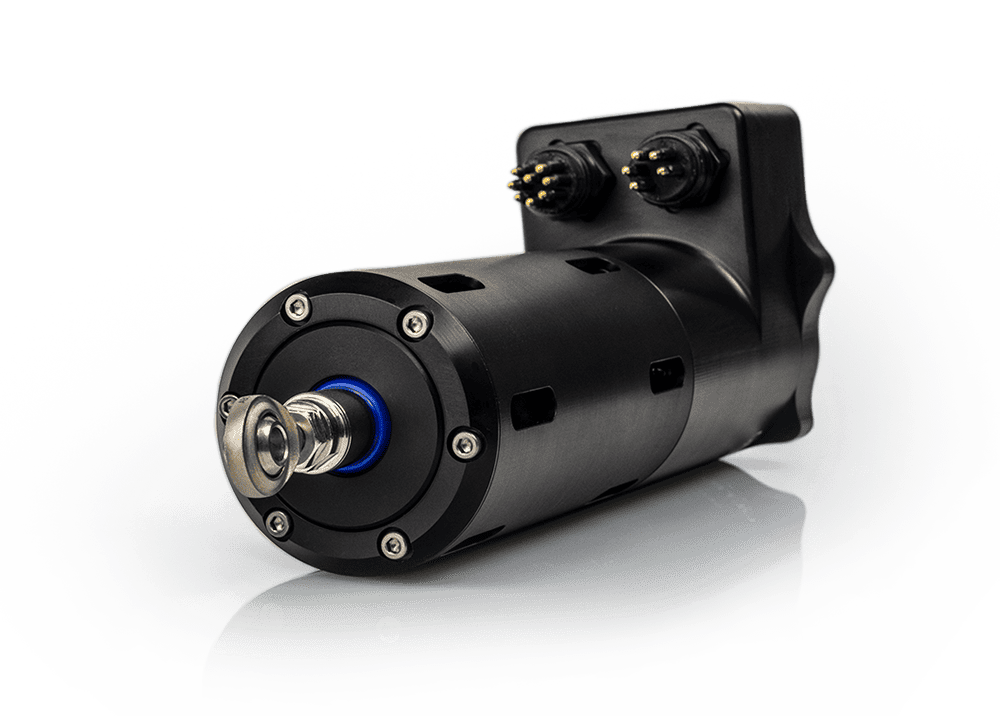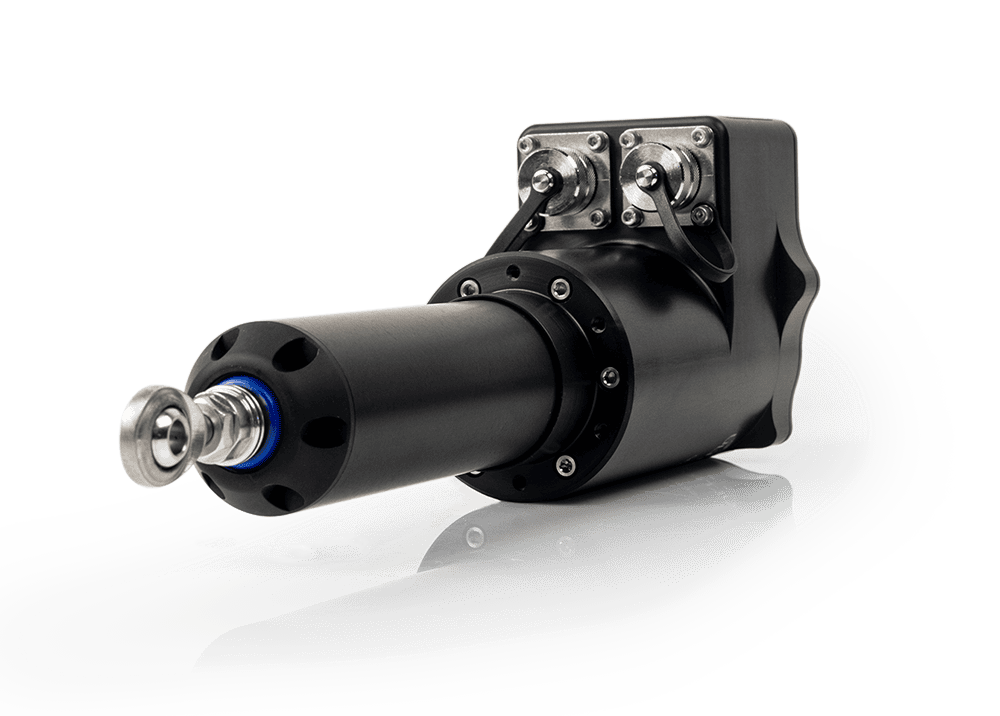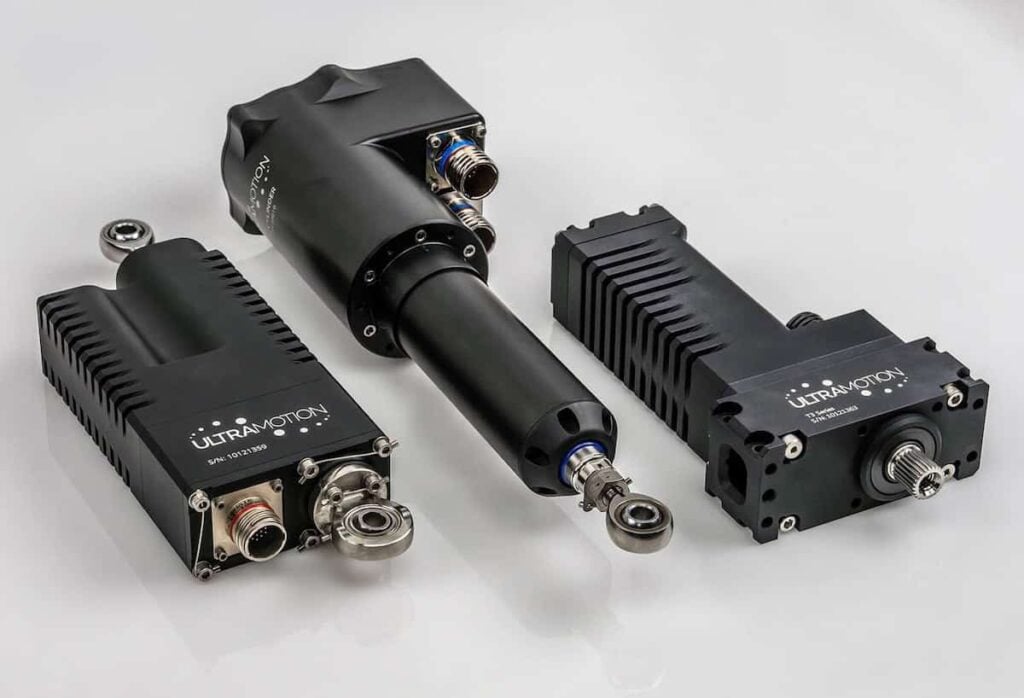

In this Q&A, Ultra Motion provides insight into how its servo actuator technologies are engineered to meet the stringent demands of defense, aerospace, and unmanned platforms.
The article explores how the T-Series rotary actuators maintain performance under high shock and vibration, and how the L-Series linear actuators incorporate advanced redundancy and fail-safe features to support mission-critical applications where reliability and fault tolerance are essential.
Do the T-Series and L-Series Support Unified CAN-based Control for Integrated Maritime, Defense, or Unmanned Platforms?
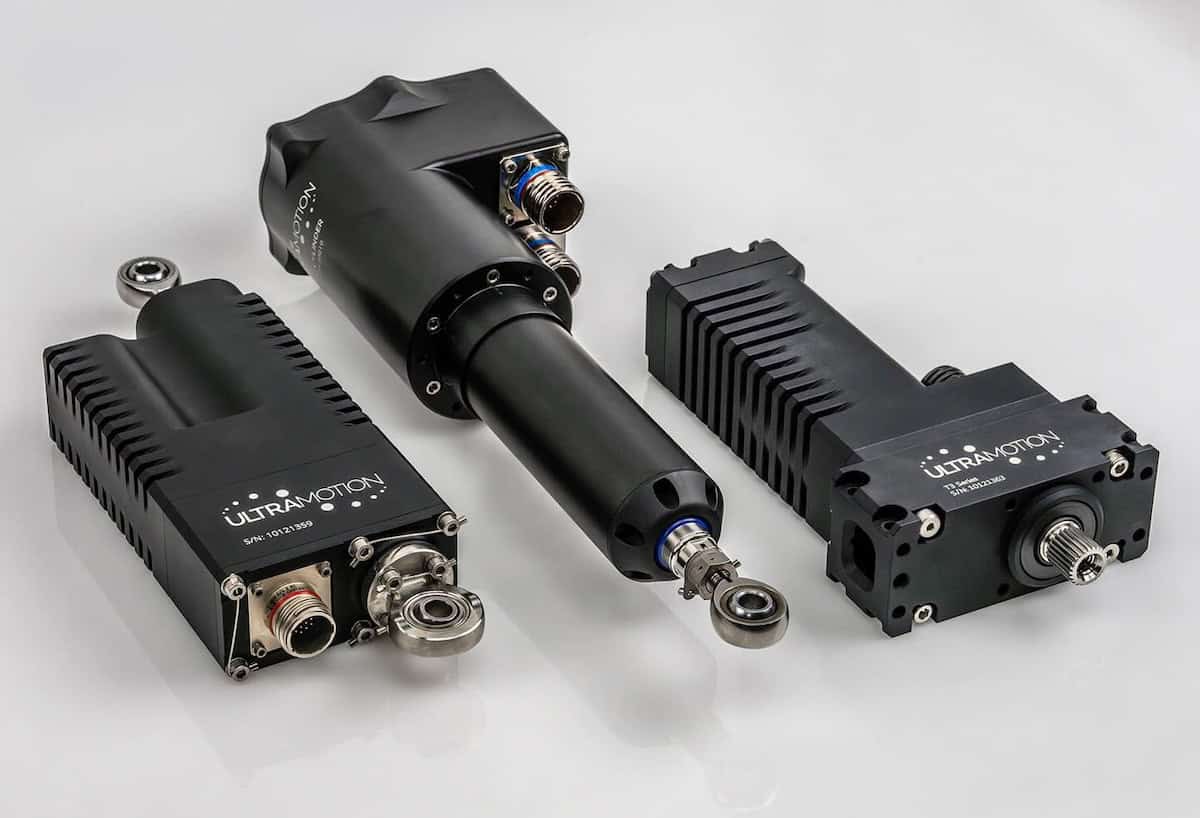
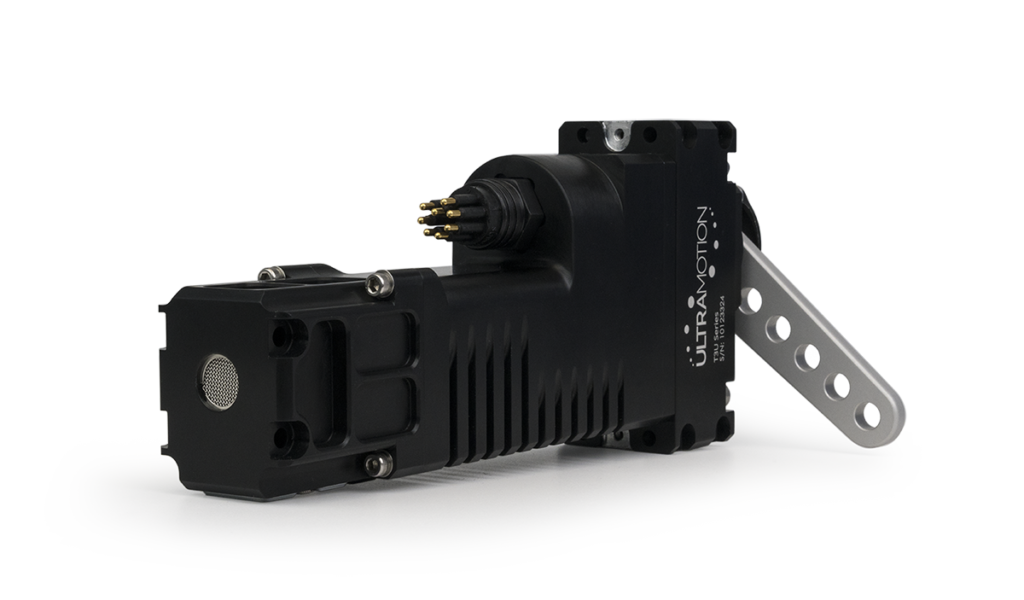
T-Series actuator from Ultra Motion.
Yes, both the T-Series rotary servo actuators and the L-Series linear servo actuators support a unified CAN-based control architecture that greatly simplifies integration with modern maritime, defense, and unmanned platforms. In addition to CAN 2.0B, these actuators also support RS-485 serial communication, and the T-Series offers optional RC PWM control as well, enabling flexibility across diverse control systems.
Using the same CAN protocol across these product lines means host controllers, whether in AUVs, USVs, UAVs, or shipboard systems, can manage position commands, motor currents, and telemetry uniformly. This includes absolute position feedback, motor health parameters (phase current, temperature, and bus voltage), and error states, all accessible over a common network. That unified interface reduces wiring complexity and accelerates integration into vehicle control systems, autopilots, or defense mission computers without needing unique drivers or gateways for each actuator type.
Because CAN 2.0B is compatible with many off-the-shelf flight computers and embedded controllers, developers can integrate Ultra Motion actuators into autonomous guidance systems, mission computers, or platform controllers with minimal custom networking overhead.
How Do the T-Series Rotary Actuators Perform Under High-Shock and Vibration Typical of Defense Platforms?
Ultra Motion’s T-Series rotary servo actuators are engineered specifically for operation in harsh environments where shock, vibration, and dynamic loading are common, such as airborne defense systems, unmanned vehicles, naval platforms, and subsea applications.
At the core of their robustness is a mechanically optimized design that pairs a high-power density brushless DC motor with a planetary gearhead and a structurally resilient spur geartrain. This configuration inherently improves resistance to transient loads and reduces susceptibility to gear fail-out under shock or high-vibration events.
Internally, critical components are supported and potted to reduce micro-movement under stress, while the housing itself is hardcoat anodized with full EMI/EMC protection to mitigate electrical noise and maintain signal integrity during rapid motion and vibration. IP67 sealing ensures environmental protection, and D38999 connectors are used for rugged, field-serviceable interface reliability.
The actuator’s contactless absolute position feedback system and integrated controls further help maintain reliable position tracking even when subjected to shock loads that might upset lesser systems. This combination of structural strength, advanced internal retention techniques, and environment-ready design enables the T-Series to maintain high performance and control authority in demanding defense scenarios.
What Redundancy or Fail-Safe Features in the L-Series Make Them Suitable for Mission-Critical Defense Mechanisms?
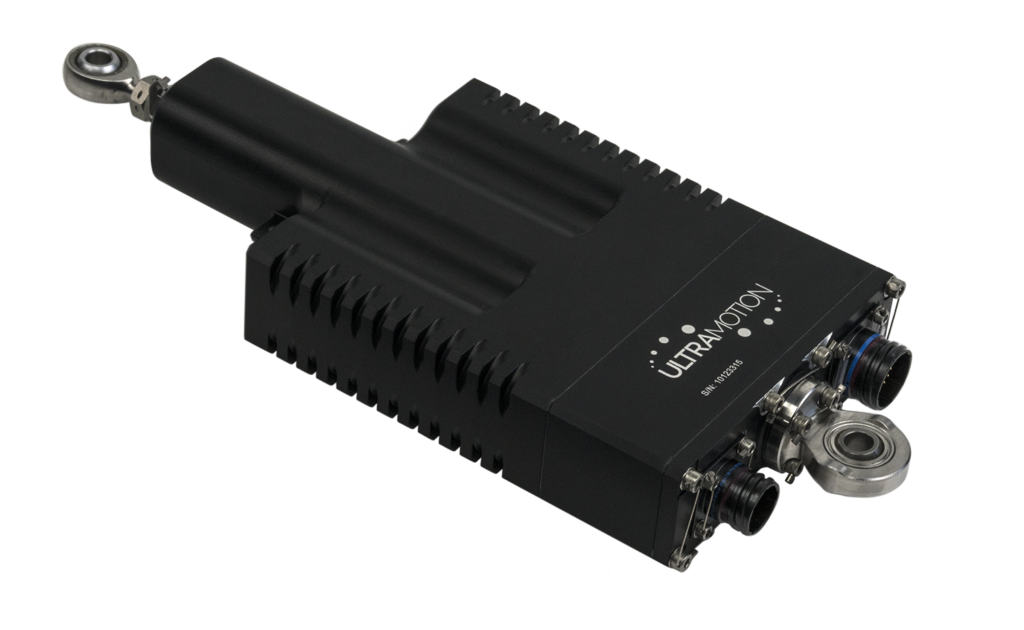
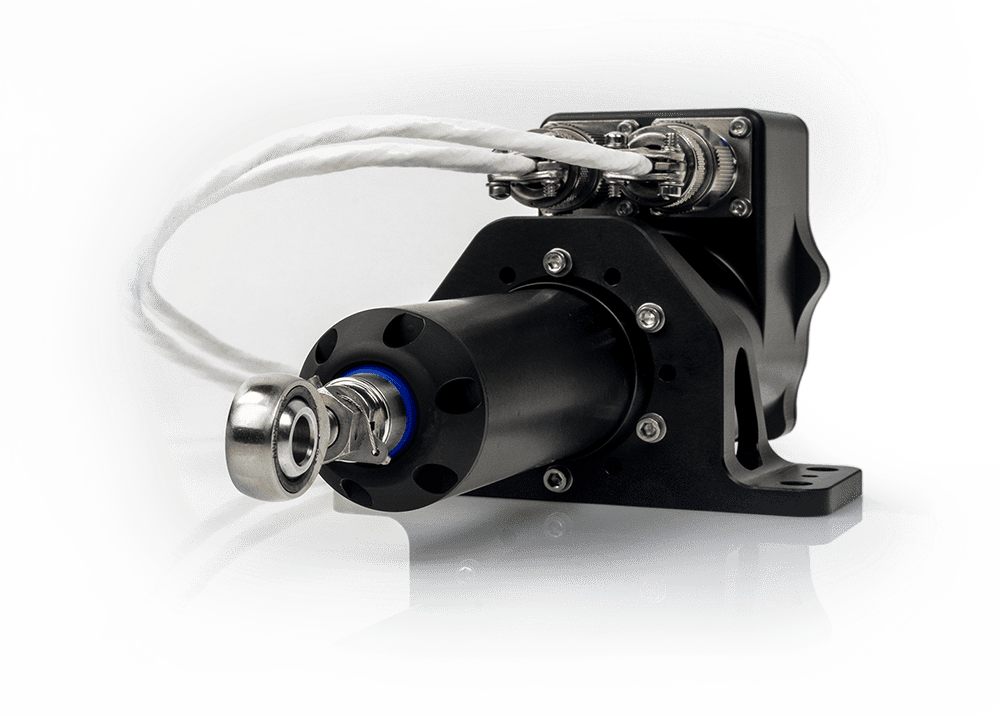
The L-Series, and specifically the L2D dual-redundant linear servo actuator, is designed from the ground up for mission-critical systems where fault tolerance and fail-safe operation are essential. At the heart of this capability is a fully redundant control architecture that incorporates two independent BLDC motors, two separate motor control electronics channels, and three absolute position sensors, all housed within a single mechanical actuator.
Each feedback and control channel is 100 % electrically isolated, meaning no internal sharing or arbitration occurs — the host system retains full authority over how redundancy is managed. This allows the user to implement redundancy in either a cold-standby mode (where the secondary system remains inactive until needed) or an active load-sharing mode that divides actuation loads between channels to enhance performance.
To further enhance safety, each controller includes an optically isolated enable input that bypasses onboard microcontrollers and provides direct hardware enable/disable of the BLDC bridge. In the event of a software or controller fault, the actuator can be disabled at the hardware level, removing power to the motor and effectively locking the system in a known state.
In addition to redundant motors and electronics, the triplicated absolute position sensors provide independent position feeds that can be compared externally to detect and isolate failures, a critical feature in flight control surfaces, precision weapon systems, or autonomous mission actuators. The integrated CAN 2.0B and RS-485 communication interfaces also allow detailed telemetry and health reporting back to host systems, enabling real-time condition monitoring and predictive maintenance.
These combined features make the L-Series particularly suitable for aerospace, defense, and unmanned platforms where reliability, fault isolation, and continued operation under single-point failures are critical mission requirements.
Which Industries or Application Sectors Do You Expect to See The Fastest Growth in Demand for Your Actuators, and How is Ultra Motion Preparing (e.g. via Partnerships, Scaling, Custom Solutions)?
Our servo actuators are purpose built for use in unmanned vehicles across all domains, and we will continue improving and expanding on our products to stay on the cutting edge of performance and reliability in harsh environments.
Ultra Motion has extensive heritage in space applications, including crewed spacecraft, thrust vector control of upper-stage and orbital transfer vehicle engines, and even have several actuators on the lunar surface. The new-space industry is taking off, and we have a variety of solutions available that we expect to continue being a driver of new business.
Our products ability to perform in the harshest environments make them popular in defense applications, and being manufactured in the USA is another benefit for the defense industry.
The subsea market is growing fast and the addition of a submersible rotary actuator to our subsea product line is something we are all excited about.