

GPS & GNSS Receivers
Discover cutting-edge solutions from 5 leading global suppliersGNSS.store, a developer and manufacturer of ultra-reliable Positioning, Navigation and Timing (PNT) solutions, explains how chip length, modulation rate, and constellation coverage influence the performance of L1/L5 and L1/L2/E5b receiver designs.
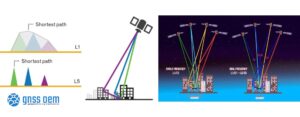
A chip’s length sets the achievable measurement precision. The GPS L1 C/A code uses a 1.023 megahertz rate, producing a chip near 1 microsecond, or about 300 meters, and receivers typically resolve roughly 1/100 of that interval, close to 3 meters. GPS L2C follows a similar chip scale. GPS L5C operates at 10.23 megahertz, reducing chip length by a factor of 10. This enables accuracy near 0.3 meters and improves handling of reflected paths because a delay of about 30 meters is roughly 1/10 of an L2C chip but approaches an entire L5C chip, allowing clearer separation of the direct signal.
Satellite coverage differs among these services. GPS currently broadcasts L2C from 24 satellites and L5C from 17 satellites, with L5C availability expected to increase as new units launch. BEIDOU shows parallel distinctions: B1I and B2I run at approximately 2.046 megahertz, while B1C and B2a operate near 10.23 megahertz. B2I is being phased out with 15 transmitters, whereas B2a is carried by 29 satellites. GALILEO’s E5a and E5b both use a 5.115 megahertz rate. GLONASS G1 and G2, at roughly 0.511 megahertz, offer lower-rate signals that are less advantageous when GALILEO and BEIDOU are available.
Antenna design also favors reduced band counts. Limiting the number of receive frequencies simplifies filtering and lowers overall complexity, making L1/L5 configurations more efficient than L1/L2/E5b architectures.
Operational constraints continue to affect L5C. As of February 2023, only 17 GPS spacecraft provide L5C. Aviation rules require 24 L5C transmitters before the signal can be used independently, a threshold projected for approximately 2027. Because Galileo and Beidou are not yet authorized for aviation redundancy, L5C is classified as unreliable for that domain, while L1 C/A is considered reliable.
Receiver designs therefore use the L1 C/A health status to interpret the status of L5C, allowing L5C measurements while maintaining required reliability criteria.