Accelerate Defense Modernization through Strategic Sourcing
Discover cutting-edge solutions from leading global suppliers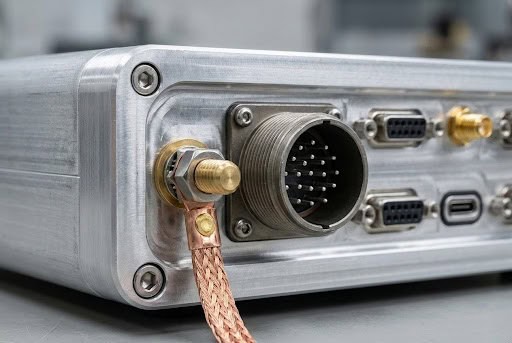
EMI problems in rugged electronics frequently emerge during integration, when a platform is fully assembled, cabled, mounted, and operating at full duty cycle. Atrenne, A Celestica Company, examines why achieving EMC requires shielding to be addressed as an architectural consideration across the complete embedded computing platform rather than as a material addition late in development.
A compute card that performs as expected during bench testing can behave differently after installation within a rugged chassis. Similarly, a harness that appears appropriately configured in CAD can become a noise antenna when routed around power conversion and RF. Connector panels present another consideration, since mechanical durability alone does not guarantee Electromagnetic interference (EMI) performance. Without a deliberate electrical interface, shielding effectiveness can be compromised.
These integration challenges highlight an important distinction between applying shielding and engineering for electromagnetic compatibility (EMC). Shielding needs to be considered as an architectural requirement across the platform rather than as a late-stage material addition.
Managing EMI at System Boundaries
Some of the most consequential EMI considerations in rugged embedded computing occur at system boundaries. These include locations where power and signals cross a chassis wall, internal cables transition to external harnessing, panels and covers interrupt continuity, and vents or airflow paths create openings for thermal management.
Each interface contributes to the overall shielding behavior of the enclosure. Individually minor compromises can accumulate, preventing the shielding from functioning as a cohesive system.
For this reason, efforts to improve EMI protection need to account closely for connections between the platform and the external environment. Openings, cable transitions, seams, and other boundaries can influence EMC performance.
Maintaining Electrical Continuity in Rugged Chassis
A rugged enclosure cannot be treated simply as a static Faraday box. During its service life, the structure may experience vibration, thermal cycling, maintenance access, and long-term wear. Shielding performance therefore depends on maintaining electrically consistent interfaces over time.
Several mechanical details can influence this consistency. Contact across removable panels needs to remain predictable, bonding paths need to be repeatable following reassembly, and the effects of coatings, surface finishes, and changing compression forces need to be considered.
EMI problems that appear difficult to explain can therefore originate in mechanical interfaces that have been optimized for physical fit and finish but not for electrical continuity.
This makes EMI shielding solutions a broader enclosure design consideration rather than simply a choice of gasket or finish. The complete enclosure interface needs to be designed so that its behavior remains predictable throughout the system lifecycle.
Cutouts, Seams and Openings as EMI Pathways
Solid sections of a chassis are not necessarily the areas most likely to cause EMC difficulties. I/O cutouts, connector plates, ventilation features, inspection covers, seams, and other necessary openings can provide paths through which emissions escape.
The same features may also create susceptibility pathways through which external electromagnetic energy reaches the system, particularly where external cables are involved.
Reviewing these locations as EMI-related features from the beginning of the design process can help focus attention on potential pathways. A useful design consideration is where interference would most readily enter or leave the enclosure. In many cases, this will be an opening, seam, or connector boundary rather than a solid chassis wall.
Harnessing as Part of the Shielding Architecture
External harnessing can remain a significant EMC consideration even when the chassis itself is performing as intended.
Cables may radiate internally generated noise, particularly where termination or transition is weak. They can also pick up energy from the surrounding environment and introduce it into sensitive inputs. Routing and attachment arrangements may additionally allow noise to couple between subsystems.
Selecting shielded cable alone does not constitute a completed shielding strategy. Cable shielding becomes effective at the transitions where the shield interfaces with the connector, backshell, and enclosure.
For rugged embedded computing systems, harnessing therefore needs to be treated as a first-class part of the embedded computing systems’ design rather than solely as a downstream packaging activity.
Coordinating Mechanical, Electrical and Integration Design
EMC performance involves decisions spanning mechanical, electrical, and system integration disciplines. Addressing these areas together early, before a platform is locked, provides a common basis for considering EMC across the system.
Relevant design questions include identifying which subsystems are most likely to produce emissions at full load and which signals may be particularly susceptible, including low-level analog signals, RF receive paths, and timing signals.
Their physical relationship to power conversion and high-speed digital circuitry also needs consideration. Teams can identify intentional bonding points and return paths rather than allowing these paths to be established by accident.
Service requirements add another dimension. Interfaces that will be opened and reclosed during maintenance need to preserve electrical continuity following access and reassembly.
The resulting engineering task extends beyond defining what EMI shielding is. The focus instead becomes how to make the platform’s behavior repeatable across its mechanical, electrical, and integration interfaces.
Using Pre-Compliance Testing as an Engineering Feedback Loop
Learning about EMC problems late in development can create significant difficulties. Pre-compliance activity can instead provide feedback earlier in the development process.
This work does not necessarily require a complete laboratory setup to provide useful information. Even lightweight pre-compliance testing can help distinguish between several possible sources of a problem, including a boundary issue involving a connector panel, opening, or seam; a harness-driven radiator; a conducted path requiring boundary control; or coupling associated with integration or layout.
The value extends beyond passing sooner. Early feedback can keep corrective measures structural, including changes to interfaces, routing, or enclosure details, rather than relying on scattered, last-minute patches.
Treating EMI Shielding as a Platform Attribute
For rugged electronics, EMI shielding can be approached as an attribute of the complete platform, encompassing the chassis, connectorization, harness strategy, and system integration plan rather than as a material decision applied after the fact.
Atrenne works at the intersection of rugged chassis design, embedded platforms, and system integration details. Within a platform-and-integration approach, mechanical considerations such as seams, serviceability, and thermal constraints can be aligned with electrical factors including bonding, return paths, and cable transitions.
Bringing these considerations together supports an approach in which EMI control can hold up both in the lab and in the field, without overbuilding the system or impacting schedules. In this model, shielding is incorporated throughout the platform architecture and integration process rather than addressed as an isolated addition late in development.